
In 2038, Idaho was watching the same fight play out across the country. Demand for data-center capacity was accelerating. So were local objections. Communities argued over water use, power demand, transmission projects, noise, land consumption, and miles of windowless industrial buildings. Projects that had once moved from announcement to construction with little public attention were beginning to spend years in hearings, appeals, utility proceedings, and local political fights.
Camille Chastain was serving in the Idaho Legislature at the time. Working with the governor and lawmakers from both chambers, she helped advance a different proposition: Idaho would compete aggressively for hyperscale investment, provided the industry agreed to a physical design and fiscal structure written around Idaho's long-term interests.
The idea was simple enough to describe. Large compute facilities would go underground. Cooling systems would minimize consumptive water use. Operators would carry the cost of the electrical infrastructure created by their load. The state would offer construction credits and a stable, competitive long-term tax environment. Idaho would seek revenue from a large number of facilities operating for decades, along with jobs, supplier growth, lease income, power infrastructure, and a negotiated share of marketable compute capacity.
At the time, engineers questioned the cost. Fiscal conservatives questioned the credits. Utility executives questioned the load. Hyperscale companies questioned why they should accept an expensive construction standard when other states would still let them build a conventional campus on a slab.
Those questions shaped the policy.
The 2038 Bet
Idaho's starting assumption was that national demand for compute would continue rising for decades. The state also assumed that public resistance to very large surface campuses would rise with it. That created an opening for a state willing to solve the physical complaints before the projects arrived.
The legislature's early framework, later commonly called the Idaho Compute Compact, treated data centers as long-life industrial infrastructure. The state did not promise companies the cheapest possible building. It offered a predictable place to operate for thirty years or more.
Qualifying projects received performance-based credits tied to the additional cost of Idaho's underground standard. Credits became available as construction milestones were completed and facilities entered service. They could reduce an operator's Idaho tax liability, although they could not create a negative liability or require the general fund to issue a cash refund. The agreements also established fixed rules for the life of the incentive period, including environmental obligations, reporting requirements, clawbacks, and limits on project-specific tax changes.
That last point mattered to the companies. A data center cannot move after billions of dollars have been sunk into rock, concrete, electrical equipment, fiber, and cooling infrastructure. Idaho offered regulatory certainty alongside the credit. Companies knew the tax rules, the construction rules, and the operating requirements before excavation started.
Why Put the Compute Underground?
The underground requirement drew the most criticism in the early years because conventional hyperscale construction had been optimized around speed and cost. A large surface data center could be built as a repetitive industrial structure with easy equipment access, straightforward expansion, and mature construction practices. Idaho asked operators to excavate, waterproof, reinforce, ventilate, compartmentalize, and service large spaces below grade.
The engineering case depended on scale and repetition. Idaho did not pursue single multi-gigawatt underground megastructures. The state favored a larger number of smaller regional campuses, usually measured in hundreds of megawatts, distributed across sites with suitable geology, transmission access, and fiber routes. No single campus carried the state's entire compute economy.
Geotechnical review came first. Sites were screened for competent ground, groundwater behavior, faulting, drainage, construction access, and long-term serviceability. The standard evolved toward repeatable buried halls built with automated excavation, modular structural components, large service galleries, replaceable mechanical systems, multiple egress routes, and compartmentalized fire zones.
Maintenance engineers also won several arguments. Idaho's later standards required freight shafts and equipment routes sized around replacement, not initial installation. Cooling loops were divided into isolatable sections. Ventilation and life-safety systems were independently powered. Critical pumps and heat-rejection controls were designed around redundant electrical and manual control paths.
The result cost more to build. That remained true even after construction methods improved. The state's position was that the premium purchased land protection, security, lower noise, reduced surface industrialization, wildfire resilience, weather protection, and a much smaller permanent footprint.
The Heat Still Has to Go Somewhere
The laws of thermodynamics remain in force. Nearly every megawatt consumed by a data center ultimately leaves the site as heat. Burying the servers does not make that energy disappear. Idaho's standard focused on how the heat was collected, transported, and released.
Inside the campuses, closed-loop liquid systems carry heat away from computing equipment. Later generations use increasingly direct liquid cooling, with propylene-glycol heat transport through isolated loops and large heat exchangers. The surrounding earth provides thermal stability and short-term buffering, although it is never treated as the permanent heat sink.
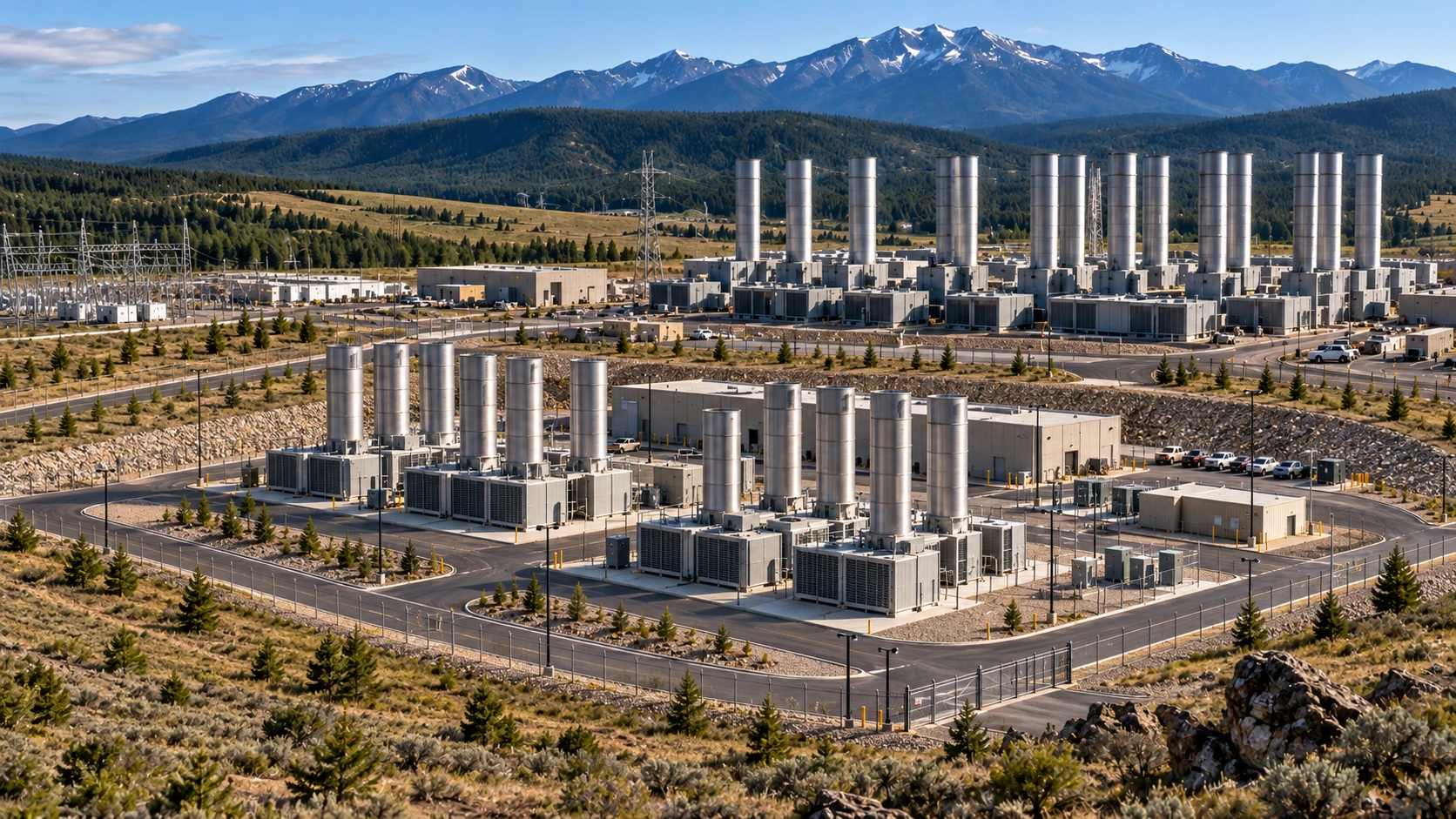
At the surface, the thermal load is concentrated into engineered rejection fields. Roughly forty-foot stacks discharge large volumes of heated air vertically at high velocity. Each site is modeled for plume rise, prevailing winds, inversions, recirculation, nearby terrain, roads, structures, and aviation. The goal is to carry the plume above the immediate ground-level environment and mix it into a much larger volume of atmosphere.
That approach reduces the persistent local heat island created by acres of surface cooling equipment. It also allows the permanent industrial footprint to remain concentrated around service areas and stack fields while the land above and around the buried halls is restored.
The system consumes energy for pumps and fans. Idaho's rules account for that energy in the facility's total power plan. Operators accepted the efficiency penalty in exchange for the permitting certainty, land access, security, and long-term economics available in the state.
Water Was a Hard Limit
Water policy became one of the easiest parts of the plan to explain to Idaho residents. Large evaporative cooling systems can consume significant quantities of water because evaporation is an efficient way to reject heat. That trade becomes difficult in a western state where agriculture, households, rivers, reservoirs, and drought planning already compete for the same resource.
Idaho's qualifying standard sharply limited routine consumptive cooling water. Closed-loop systems recirculated coolant, and plant designs were reviewed against watershed conditions before approval. Operators could not build a business case around access to cheap Idaho water and leave communities carrying the long-term resource risk.
The political promise was direct: growth in the compute sector could not depend on taking irrigation water from farms or forcing cities to redesign their water systems around server cooling.
Power Had to Arrive With the Project
Electricity presented a larger problem. A successful compute strategy could overwhelm the very grid that made it attractive. Idaho addressed that risk by placing much of the expansion obligation on the large-load customer.
Major projects were required to secure incremental firm generation, finance their interconnection, and pay for transmission upgrades attributable to the new load. Long-term power contracts gave operators predictable prices while protecting ordinary utility customers from having compute-specific infrastructure rolled into residential rates. Facilities also carried reserve and continuity requirements appropriate to their size.
Over time, the policy encouraged new generation and transmission capacity to arrive alongside the data centers. That infrastructure supported the state's broader industrial growth while preserving a clear accounting boundary between household demand and hyperscale demand.
For Chastain and the governor, this was central to the politics. Idaho residents were being asked to accept a new industry at enormous scale. The industry had to arrive with its own answer for power.
The Tax Question
The early tax credits were controversial for an obvious reason. A state cannot build a durable economic strategy by giving away revenue and hoping activity appears later. Idaho's answer was to cap the incentive, keep it nonrefundable, tie it to performance, and measure it against the revenue and contractual value created by the project.
The state also pursued a lower, stable long-term effective tax burden than many competing jurisdictions. The fiscal model relied on volume. A larger number of companies paying predictable annual taxes could produce more total revenue than a small number of operators facing a high rate.
That approach required discipline elsewhere in the budget. The strategy assumed Idaho would keep recurring spending within recurring revenue, maintain strong reserves, and avoid building permanent obligations around temporary boom-year receipts. When compute-driven revenue grew faster than the cost of government, the state could preserve competitive tax rates and still strengthen its fiscal position.
Credits were treated as an investment in the additional construction Idaho required. As the underground construction industry matured, the premium fell and the credits could narrow. Specialized contractors, automated excavation systems, local engineering firms, cooling suppliers, and trained trades all reduced the cost of the next project.
Idaho also negotiated value outside the corporate tax bill. Agreements could include land and subsurface leases, infrastructure charges, long-term power arrangements, and an allocation of standardized marketable compute capacity. The percentage varied by project and by the size of the incentive package.
That compute allocation became increasingly valuable as national compute markets standardized. Idaho could use part of its allocation for universities, public services, emergency operations, and state research. Surplus capacity could be leased to federal agencies and commercial users. Those proceeds helped offset revenue sacrificed through construction credits and created a continuing return from the infrastructure after individual incentives expired.
The agreements were designed to avoid a later tax ambush. Operators knew the terms when they committed capital. Idaho retained its ordinary statewide taxing authority, while project-specific incentive compacts protected companies from targeted surcharges created solely because the facilities could no longer leave.
Why Executives Eventually Said Yes
In the first years, Idaho's requirements were difficult to sell. A hyperscale executive could point to another state where a surface campus was cheaper and faster. Idaho's advantage grew as the national siting environment changed.
Elsewhere, some projects faced years of local opposition, contested power connections, water restrictions, shifting zoning rules, litigation, and political pressure after announcement. A nominally cheaper project could become very expensive if the permit date, energization date, or operating rules remained uncertain.
Idaho offered a different cost profile. Construction was more demanding. The state helped offset the incremental premium. Permitting followed a defined technical standard. Power obligations were known. Water limits were known. Tax treatment was known. Environmental requirements were known. Once a project met those conditions, the company had a clear path to operation.
That certainty carried measurable value. Delaying a large compute campus by two years can strand equipment orders, power contracts, customer commitments, and billions of dollars in capital. A higher construction cost with a reliable schedule can beat a cheaper project trapped in an uncertain approval process.
As more campuses opened, the logic strengthened. Idaho developed the contractors, transmission corridors, photonic backbone, equipment suppliers, workforce, and operating experience that the next project needed. By the 2050s, companies were no longer evaluating Idaho as an unusual experiment. They were evaluating an established compute ecosystem.
Why Idaho Could Be Far From the User
Early data-center planning placed a premium on proximity because interactive services were sensitive to latency and large datasets were costly to move. By the 2050s, the national network had changed enough for a much larger share of heavy computation to live far from the person consuming the result.
The Q-Net did not abolish distance. Classical payload data still moved as light through high-capacity photonic fiber. Quantum channels provided security, authentication, key distribution, and specialized network services alongside the classical optical traffic. Major trunk routes used advanced low-latency fiber and photonic switching to reduce conversions, queues, and inefficient routing.
More important, latency-sensitive work moved toward the edge. Phones, vehicles, buildings, robots, and metropolitan edge nodes handled immediate control, user-interface response, local inference, caching, and safety-critical decisions. Idaho's underground campuses handled the heavier layer: large-model inference, training, simulation, scientific work, national analytics, federal workloads, model updates, and other jobs where a few additional milliseconds were irrelevant.
The national architecture became layered. Local systems handled immediacy. Regional nodes handled caching and interactive services. Idaho provided scale.
From Boise to Washington, 2044
Chastain entered the U.S. Senate in 2044 with the Idaho model already under construction. Her national position gave the state access to a second phase of the strategy.
She pushed for federal recognition of hardened distributed compute as strategic infrastructure, supported national Q-Net trunk expansion, worked on federal procurement rules that allowed agencies to reserve standardized compute capacity, and backed transmission and generation policies that gave large-load projects a clearer path to build the power they required.
Those policies applied nationally. Idaho benefited because it had prepared years earlier. Its underground campuses already met many of the security, continuity, cooling, and network requirements federal customers were beginning to demand.
Federal agencies became major buyers of secure compute capacity. Idaho's state-held allocation gained a market beyond private users, and operators gained large customers willing to sign long-duration contracts. Later negotiations connected federal access to Idaho's growing underground compute reserve with broader agreements over land management and state control.
What the Land Looks Like Afterward
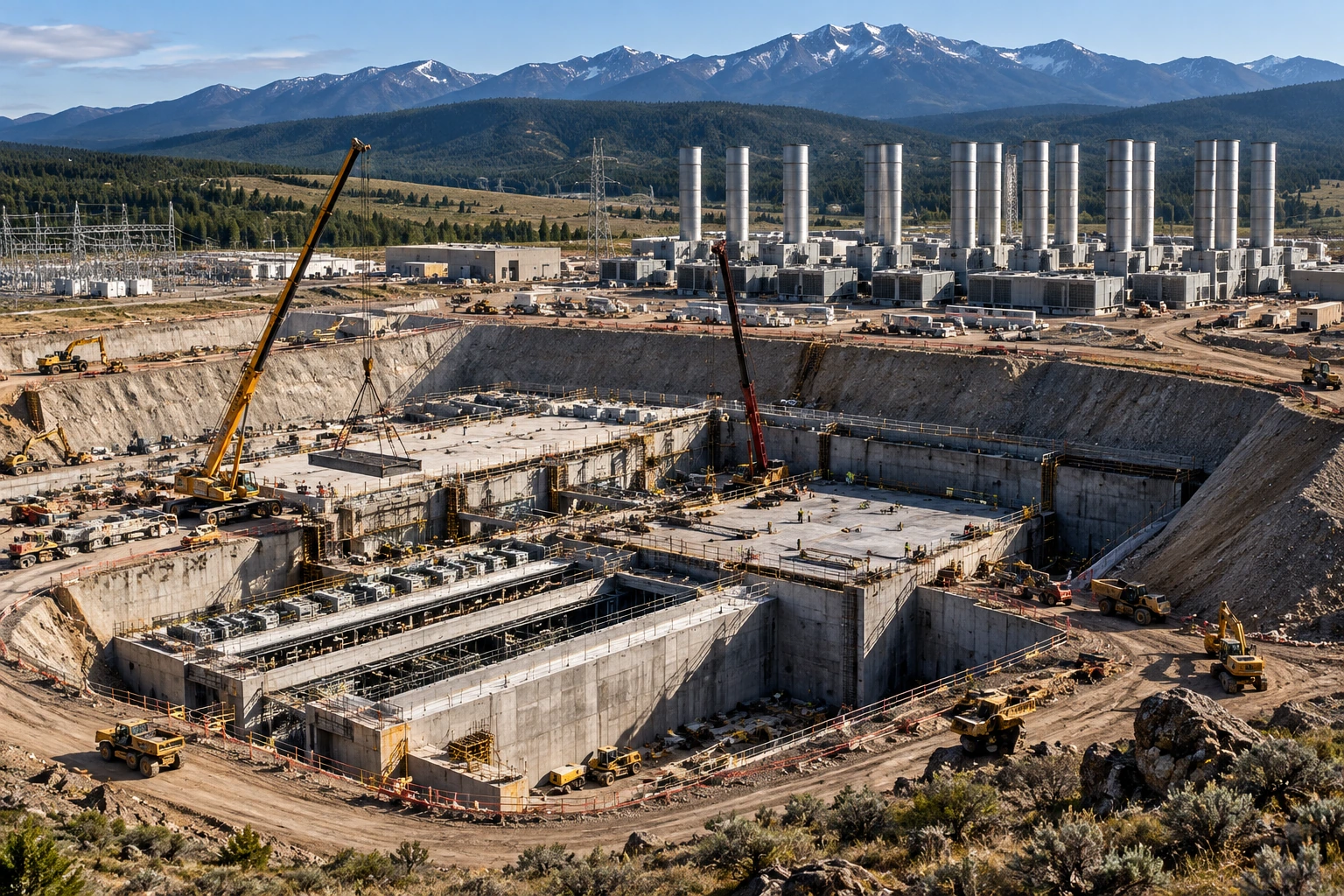
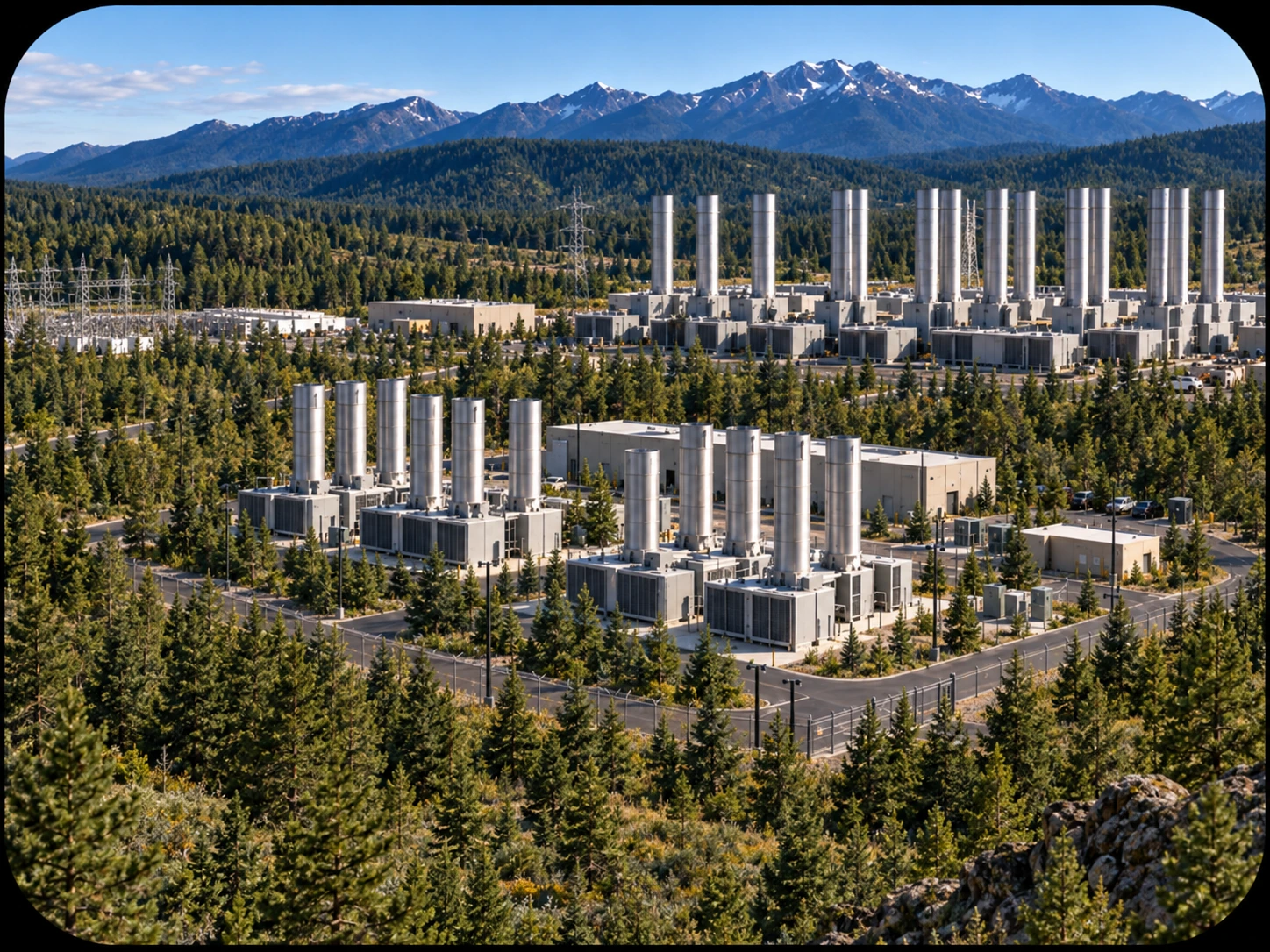
The final measure of the physical strategy is visible from above. During construction, an Idaho campus can look severe: excavated earth, cranes, concrete halls, temporary roads, electrical work, and mechanical installation. After burial, most of that geometry disappears. Access buildings, substations, roads, security infrastructure, and heat-rejection stacks remain visible.
Restoration continues around them. Soil is replaced. Native vegetation returns. In forested districts, trees eventually grow over and between large portions of the buried footprint while required clearances are maintained around roads, substations, access points, and stack equipment.
The Result
By 2054, Idaho had become America's third-largest data-center state. The outcome came from a policy that accepted the growth of compute as a long-term economic reality and placed conditions around how that growth could occupy Idaho.
The centers remained expensive pieces of infrastructure. They still required enormous amounts of electricity. Their waste heat still entered the atmosphere. Underground construction still demanded careful geology, drainage, fire engineering, maintenance planning, and redundant cooling. Those facts were incorporated into the standard instead of being hidden behind the promise of new jobs.
The state gained a broad tax base from many operators paying comparatively modest annual rates, a large construction and engineering sector, new power and network infrastructure, access to nationally valuable compute capacity, and a growing supplier economy. Idaho families were insulated from the direct water and grid costs that had driven opposition elsewhere.
For Chastain, the policy became an example of the argument that has defined much of her public life: powerful technology can create enormous value when public rules are written early, human institutions remain in control, and communities are allowed to decide the terms under which that technology enters their lives.