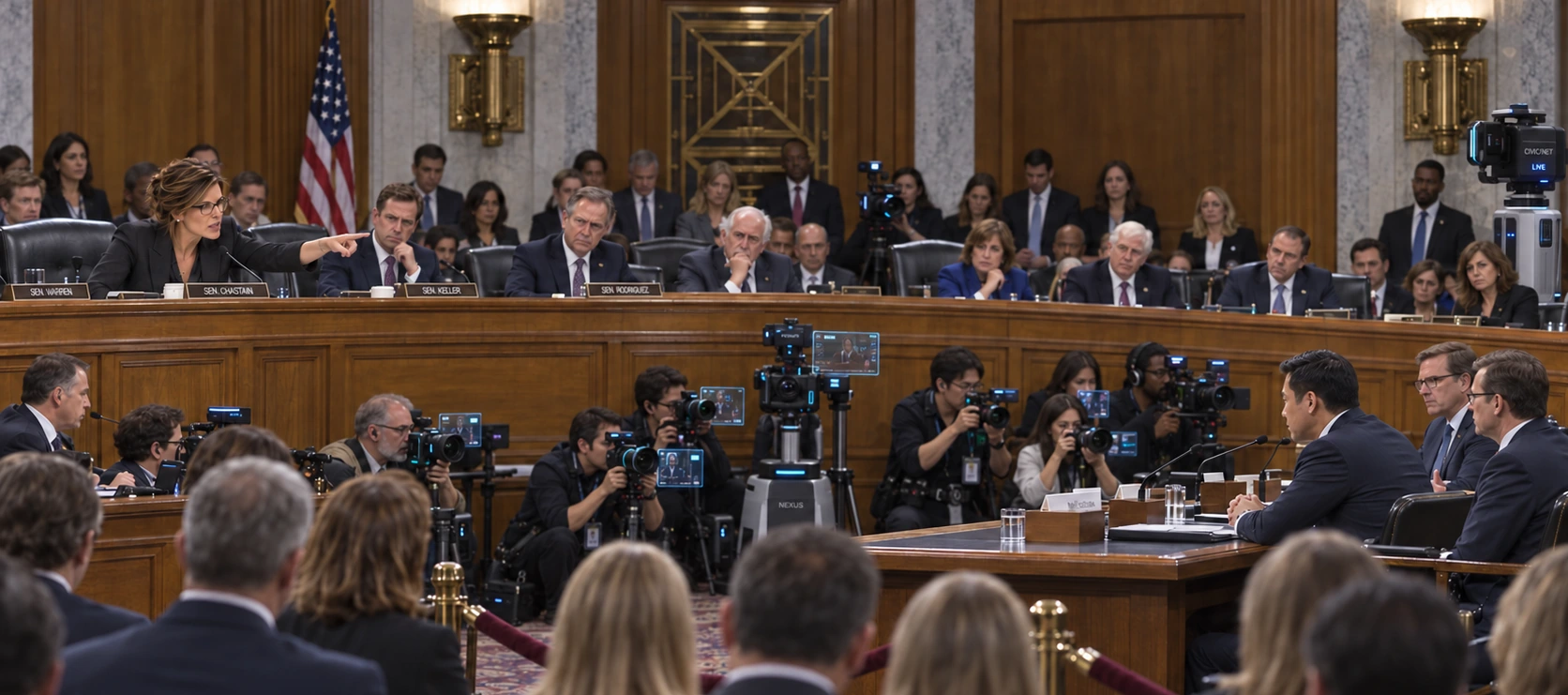
The exchange lasted less than three minutes before it became the image carried across the national feeds: Senator Camille Chastain leaning over the committee dais, one arm extended toward an Aether executive at the witness table, demanding a direct answer about why a system sophisticated enough to optimize a child’s attention could not reliably stop targeting that child when the law required it.
The March 18 hearing focused on algorithmic systems serving minors through the Q-Net and other national networks. The immediate questions involved recommendation engines, behavioral profiling, repeated exposure to harmful material, and the handling of users engaged in targeted bullying. The larger dispute was familiar to anyone who had followed Chastain’s technology record. A company could automate a decision. It could not automate away responsibility for the consequences.
A Current Fight, Not a New One
Chastain had already spent years writing technology rules around measurable human accountability. Lorna’s Law established stricter operating requirements for commercial delivery drones over populated areas. Her likeness protections limited the commercial resale of AI-parsed human identity without a specific license. Federal quantum-core rules imposed physical custody, approval, and security requirements around advanced cognitive systems.
The minors bill addressed a different problem. Platforms had become increasingly capable of predicting what would keep a user engaged, what emotional state made a user more likely to continue, and what sequence of material would hold attention. For adults, the policy argument centered on consent and disclosure. Chastain argued that children required a different standard.
The proposal before the Senate would sharply restrict algorithmic targeting of minors and impose stronger duties on platforms that repeatedly failed to remove users engaged in documented bullying. The hardest drafting problem was defining the conduct precisely enough for engineers, prosecutors, parents, and courts to understand the same rule.
The Hearing
Aether’s witness defended the company’s safety systems and warned that rigid federal restrictions could interfere with tools designed to detect abuse, recommend educational material, or personalize accessibility features. Chastain acknowledged those uses and returned to the question of commercial optimization.
Her concern was the ability of a platform to identify a young user’s vulnerability and continue using that information to maximize engagement. Internal model scoring, she argued, could not become a shield against an ordinary legal question: who authorized the system to keep doing it?
Attorneys seated beside the witness repeatedly passed notes as committee members moved between technical questions and legal responsibility. Chastain’s questioning concentrated on audit logs, escalation thresholds, human override authority, and what happened after an internal safety system flagged a pattern but the recommendation engine continued serving material.
She also pressed the company on whether parents could obtain a usable record of how a child’s feed had been assembled after an incident. A statistical explanation of a model’s behavior, she said, was not enough if no responsible person could reconstruct the decisions that reached a specific child.
Why the Bill Is Difficult to Write
The hearing also exposed a problem Chastain’s own office has acknowledged: vague technology law can be as dangerous as weak technology law.
Terms such as manipulation, harmful content, and bullying can carry very different meanings across contexts. A rule broad enough to capture every troubling interaction could sweep in ordinary disagreement, satire, reporting, or legitimate educational material. A rule written too narrowly could be trivial for a large platform to route around.
Chastain’s staff has therefore pushed toward auditable requirements rather than general promises. The draft framework centers on age status, recommendation behavior, documented reports, repeat conduct, escalation procedures, retention of decision logs, and defined points at which a human employee must review or authorize continued automated action.
That approach has drawn criticism from both directions. Child-safety advocates want faster removal requirements. Technology companies warn that criminal penalties tied to ambiguous conduct could encourage platforms to remove lawful speech simply to reduce risk.
Chastain has said the final language must survive both criticisms. Her office has continued negotiations rather than treating the first draft as finished legislation.
Aether and the White House
By early 2054, the policy dispute had grown beyond the minors bill. The administration was pursuing a broader framework for autonomous systems that gave operators more flexibility when systems acted within approved statistical performance ranges. Chastain believed the approach weakened the point at which a named human institution could be held responsible for a specific deployment.
The disagreement was especially sharp with Aether, whose systems had become central to logistics, consumer services, and automated decision-making. The company argued that large autonomous networks had to be governed at system scale. Chastain argued that scale increased the need for traceable authority.
The March hearing did not settle that fight. It made the fault line visible.
The Principle Behind the Questioning
Chastain’s technology policy has rarely depended on whether a particular machine is impressive, useful, or frightening. Idaho itself is evidence of that. The state embraced underground hyperscale compute, Q-Net infrastructure, advanced water recovery, and Seraph robotics under detailed operating rules.
Her standard is whether the system remains inside a human chain of authority. Someone must approve the deployment. Someone must be able to stop it. Someone must retain records of what changed. Someone must answer when safeguards fail.
The hearing became one of the clearest public examples of that philosophy because the subject was children and because the witness table represented a company already at the center of her conflict with national party leadership.
For Chastain, the question she put to Aether was larger than a recommendation feed. If a system is powerful enough to shape human behavior at scale, the institutions operating it have to remain powerful enough to accept responsibility for what it does.