
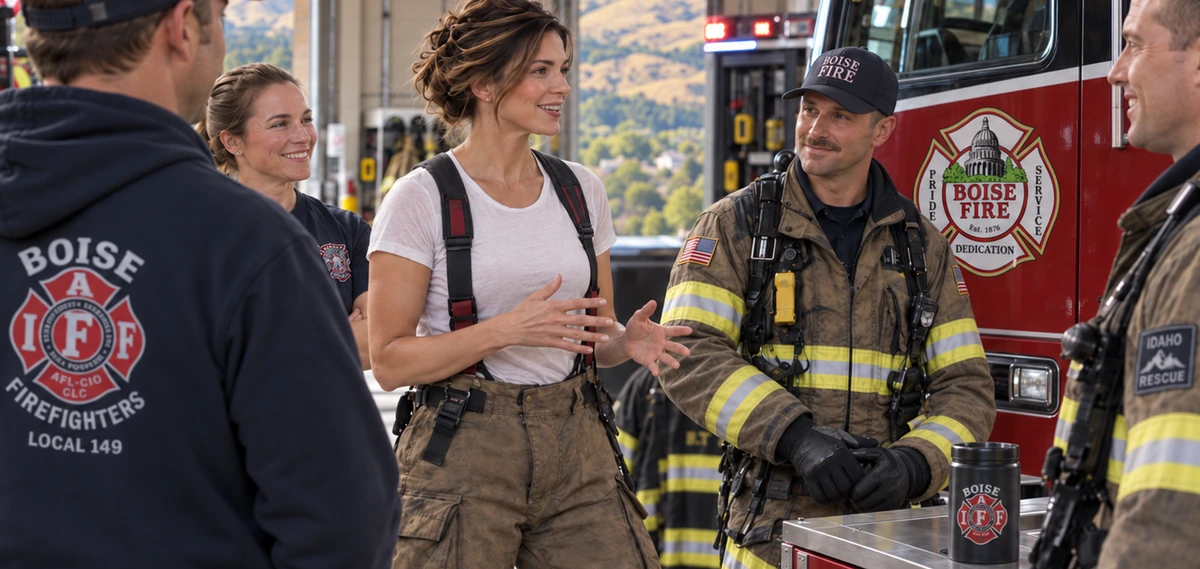
Camille Chastain’s September 2045 visit with Boise firefighters looked different from the usual first-term Senate stop. Before elected office became full time, Chastain had served as a volunteer firefighter in Idaho. She arrived at the station in old bunker pants and boots from that period, suspenders over a plain shirt, with the coat left off in the bay.
The gear was familiar enough to the crews to become a source of ribbing before the policy discussion started. It was also visibly older than the current equipment around her. Chastain had been out of active volunteer service for several years by the time she entered the U.S. Senate in 2044.
The visit followed Senate approval of a federal first-responder grant package supporting equipment replacement, training, communications, behavioral-health services, and resilience projects for local departments.
What the Grants Cover
The package expands competitive grants for fire and emergency agencies facing costs that local tax bases cannot absorb easily. Eligible expenses include protective equipment, communications systems, specialized rescue tools, station resilience, training, and health programs.
Departments can also seek support for newer vehicle and energy systems when the equipment meets operational requirements. Boise’s fleet transition included fuel-cell apparatus whose compact electric drivetrains reduced some of the packaging demands associated with older internal-combustion systems while preserving the pumps, tools, crew space, and redundancy required for emergency response.
Chastain emphasized that federal money should support local capability rather than dictate a single fleet or operating model. A mountain district, a city department, and a volunteer rural company face different response distances, staffing patterns, water supply, weather, and mutual-aid needs.
The Volunteer Fire Background
Chastain’s years in the volunteer service overlapped with her community work and the early part of her state political career. She left active service as legislative responsibilities expanded, long before her election to the Senate.
That experience has remained a visible part of her approach to first-responder policy. She tends to ask about staffing, equipment replacement cycles, training hours, communications dead zones, apparatus downtime, and who actually maintains a new system after the grant that purchased it is gone.
Firefighters at the Boise session raised a familiar concern about federal programs: a department can win money for sophisticated equipment and still lack the recurring local budget to train on it, maintain it, or replace consumable components. Chastain said grant scoring should account for lifecycle cost and local sustainment plans.
Responder Health
The legislation also increases support for mental-health and occupational-health programs. Emergency personnel face repeated exposure to traumatic calls, disrupted sleep, toxic environments, and cumulative physical strain.
Chastain backed confidential counseling access, peer-support training, and treatment pathways that do not automatically punish a responder for seeking help. Departments retain authority over fitness-for-duty decisions while employees gain a clearer route to care before a problem becomes a crisis.
Long-term exposure monitoring was another priority. Fire service health risks increasingly include the materials responders encounter after suppression as well as the fire itself. Grant programs can support decontamination equipment, protective-gear replacement, monitoring, and station design intended to keep contaminants out of living areas.
Technology in the Bay
Emergency services were already becoming more automated by 2045. Vehicles carried more sensors. Dispatch systems made heavier use of predictive routing. Drones assisted with reconnaissance. Robotic systems could enter environments where heat, collapse, or contamination made human entry especially dangerous.
Chastain supported those tools while keeping the operating chain human. A firefighter or incident commander had to remain responsible for deployment and tactical decisions. Technology could provide information, carry equipment, map a structure, or take physical risk. It did not become the incident commander.
That position later became more visible in Idaho’s rules for law-enforcement Seraphs, but the principle was already present in her first-responder work.
Local Control
Boise officials also discussed the administrative burden attached to federal grants. Small departments can spend a disproportionate amount of time documenting purchases and compliance. Chastain’s office supported standardized reporting and longer equipment cycles so departments did not have to rebuild the same application every year.
The senator left the station with a list of follow-up items from firefighters, EMS personnel, and local administrators. The session was less about announcing a new federal role in emergency response than about making existing federal support usable by the people expected to answer the call.
For Chastain, that distinction came from experience. Equipment matters. Training matters. Technology matters. At the center of an emergency scene, a human crew still has to make the decision and live with the result.