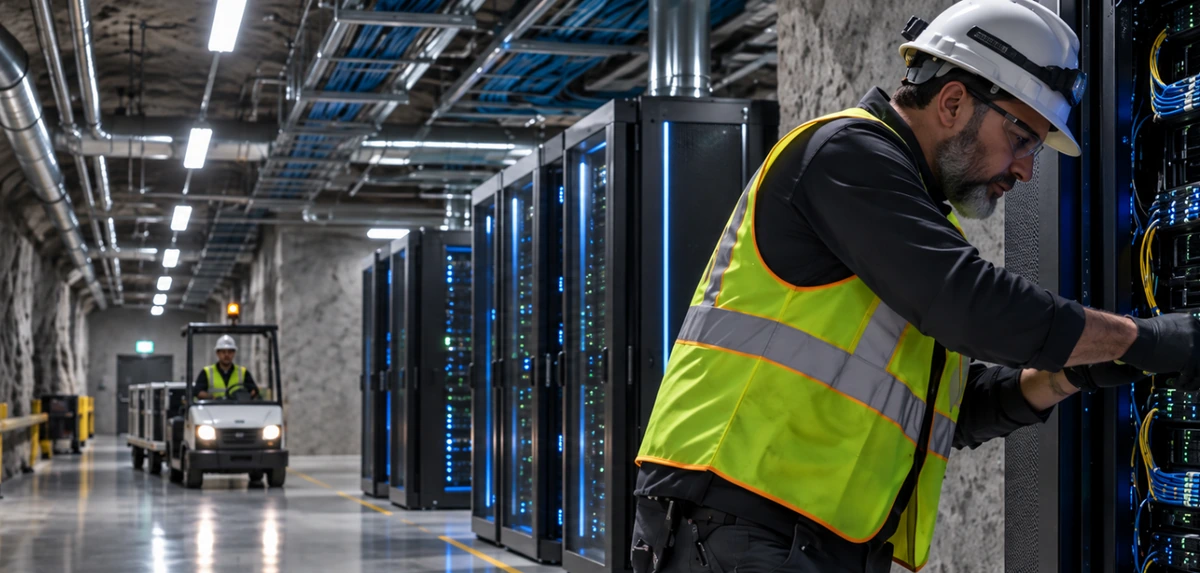
For years, the easiest way to understand Idaho’s rural connectivity problem was to look at a map of the state’s new compute corridors. Some of the fastest optical lines in the country were crossing Idaho on their way to underground data centers while farms, clinics, schools, and small towns only a few miles away still depended on older and less resilient connections.
The expansion announced September 14, 2053 was designed around that gap. Federal infrastructure resources secured with Chastain’s support, state matching funds, local cooperative investment, and required participation from major compute operators would extend secure Q-Net access into the remaining high-cost rural routes.
The investment did not create a separate rural network. It connected rural Idaho to the same backbone already serving the state’s most demanding compute customers.
The Backbone Came First
Idaho’s underground data-center strategy created an unusual advantage. Hyperscale facilities require enormous network capacity, multiple routes, low failure rates, and long-term contracts. Those requirements made it economical to build optical trunk infrastructure through parts of Idaho where a conventional rural broadband project could never have supported the cost alone.
State policy required qualifying compute projects to pay for their direct connections and participate in regional upgrades associated with the load they created. Local providers, utilities, counties, and cooperatives could connect to that expanded spine without asking rural households to repay infrastructure built primarily for hyperscale customers.
Chastain carried the same approach into federal infrastructure policy after entering the Senate in 2044. Her office pushed federal programs to recognize resilient backhaul, route diversity, and secure-network access instead of measuring success only by advertised last-mile speed.
What Q-Net Access Means for a Household
A rural home does not need a quantum computer to connect to the Q-Net. The overwhelming majority of ordinary user information remains classical data carried by photons through high-capacity optical fiber. Quantum channels provide security functions such as key distribution, authentication, trust services, and specialized connections higher in the network.
That means the last mile can still be conventional fiber or another approved local technology. A household experiences the Q-Net through a reliable connection into a secured statewide and national backbone.
The physical network matters as much as the name. Regional nodes are designed around redundant routes where terrain permits, backup power, defined repair windows, and priority restoration for critical facilities. Idaho learned from earlier rural connectivity programs that a fast connection with poor uptime is still poor infrastructure.
Hospitals, Schools, and Agriculture
Rural hospitals were among the strongest advocates for the expansion. Diagnostic transfer, specialist consultation, remote monitoring, and access to large compute resources increasingly assume a dependable network. A small hospital does not need to own a hyperscale system if it can reach one securely.
Schools use the backbone for advanced coursework, remote laboratory access, and statewide educational services. Farms and ranches use it for markets, logistics, mapping, weather, equipment support, and communications, with adoption decisions left to the operator rather than imposed by the network.
Small businesses gain access to the same national computing and communications services available in larger cities. Counties can move more public services online without treating weak connectivity as somebody else’s problem.
The Expensive Last Routes
The remaining communities are the hardest ones. Distance, mountains, sparse populations, wildfire exposure, and winter access can turn a short line on a map into an expensive construction project.
The 2053 package therefore directs money toward shared-use construction. Fiber can be installed alongside road work, transmission upgrades, utility projects, and other public infrastructure where possible. Local cooperatives can own the last mile while purchasing capacity on the larger backbone. National providers can participate without receiving exclusive control of the route.
The contracts also preserve a basic rule from Idaho’s compute policy: residents do not absorb the direct infrastructure cost created by a hyperscale campus. Compute-specific spurs, specialized equipment, and extraordinary capacity requirements remain the responsibility of the operator that needs them.
Why the Data Centers Can Be Far Away
Distance still creates latency. Idaho’s network strategy works because the architecture has become layered. Immediate control and highly interactive work can run on local devices or regional edge systems. Large-model inference, training, simulation, analytics, model updates, and other heavy workloads can run in Idaho’s underground campuses where a few additional milliseconds do not change the user experience.
The Q-Net improves routing, security, and available bandwidth. It does not violate the speed of light. Chastain’s office has made that distinction explicit because the credibility of the rural program depends on describing what the network actually does.
From 61 Percent Toward Statewide Reach
When the current rural program began, secure Q-Net access reached about 61 percent of rural Idaho. The 2053 investment focuses on the expensive remainder rather than declaring victory after the easiest communities are connected.
Some addresses will remain difficult. Some residents may decline service. Some terrain may never justify a buried fiber route to every individual property. The state’s objective is that geography should stop deciding whether an Idaho community can participate in the modern economy.
For Chastain, the program is also an example of how Idaho’s compute boom was supposed to work from the beginning. An industry that needed enormous infrastructure came to the state under rules requiring it to help build that infrastructure in ways the rest of Idaho could use.