
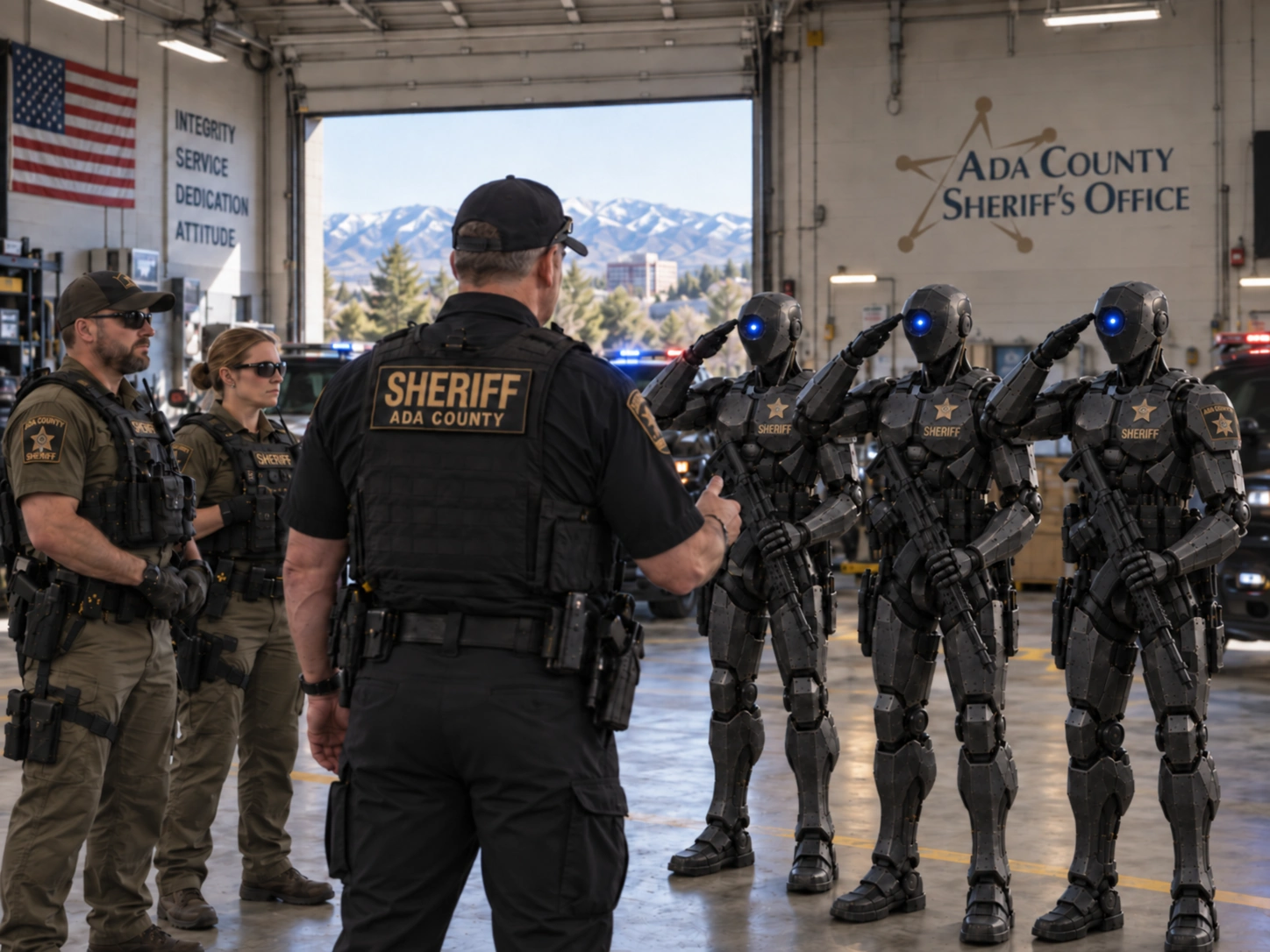
Idaho adopted law-enforcement Seraphs after the machines were already appearing in public safety systems elsewhere in the country. Chastain’s position was that the state should take advantage of the protection a robotic platform could give deputies in dangerous situations while keeping the authority to police, detain, and use force with a human official who could be held accountable by voters.
The resulting Idaho framework is unusually narrow. Municipal police departments do not receive Seraph units. County sheriffs do.
That line was intentional. Idaho sheriffs are elected county officials. Municipal chiefs of police are appointed within city government rather than chosen directly by voters. A city can request assistance from a sheriff under ordinary mutual-aid arrangements, although the Seraph remains in the sheriff’s chain of command throughout the deployment.
For Chastain, direct electoral accountability mattered once a machine could enter a home, carry a weapon, physically restrain a suspect, or move into a situation that would previously have required an armed deputy.
What Human Control Means in Idaho
“Human in the loop” is written as an operating requirement rather than a slogan. A law-enforcement Seraph may navigate, stabilize itself, map a structure, carry equipment, transmit sensor data, shield a deputy, and execute movement commands within a defined mission. It may not independently select a person for enforcement action, decide that a crime is occurring, initiate a detention, determine that force is justified, or discharge a weapon on its own authority.
Use-of-force functions require a positively identified human operator or deputy command. The authorization is logged. The unit’s sensor record, command record, software state, and operator identity are preserved for review under the same evidentiary rules that govern other law-enforcement records.
Idaho also rejected autonomous continuation after a communications failure. If the command path is lost during an enforcement mission, the Seraph enters a restricted safe state based on the circumstances and its preauthorized movement envelope. It does not continue searching for suspects or improvising enforcement activity because a machine-learning system predicts what its deputy would have wanted.
Why Municipal Police Do Not Get Them
The restriction is sometimes criticized as arbitrary. Large municipal police departments may have more personnel, larger budgets, and more specialized tactical teams than a rural sheriff’s office. Idaho’s law was written around accountability rather than organizational size.
A sheriff stands for election. Voters can judge the office’s Seraph policy, training, deployments, and use-of-force record directly. A police chief is an appointed municipal executive. That chief remains accountable through a mayor, city manager, or council, yet the public is one step farther from the official who controls the machines.
The legislature decided that robotic police power justified the narrower chain. Municipal departments still have access to conventional robotics, bomb-disposal systems, drones, and other equipment allowed under state law. When a Seraph is required, the county sheriff can provide the unit under a documented mutual-aid request.
That arrangement also prevents cities from building competing autonomous patrol systems with different rules. Idaho has one statewide Seraph standard and a locally elected official responsible for every deployment.
Three Years Without an Unauthorized Robot Injury or Fatality
Idaho has now operated law-enforcement Seraphs for more than three years without an unauthorized injury or fatality caused by a robot. The term “unauthorized” is important. It means the machine did not injure or kill a person through self-directed enforcement action, an unapproved use of force, a software decision outside a human command, or continued autonomous action after authority had been withdrawn.
Idaho is one of only seven states that can make that claim among states deploying Seraphs or comparable robotic systems in public safety. Several states permit autonomous security patrol, automated pursuit, or machine-initiated crime interdiction under broader statutory authority. Idaho does not.
The record does not prove that robots are incapable of failure. It shows what the state’s operating model has produced so far. Mechanical failures, sensor faults, network interruptions, software defects, and human mistakes are all treated as expected engineering risks. The rules are designed so those failures do not silently become independent police authority.
The Technical Safeguards
Each Idaho law-enforcement Seraph carries a hardware-rooted identity and a command log that cannot be rewritten by the field unit. Critical actions require authenticated commands over a protected control path. Software updates are signed, staged, and recorded. A sheriff’s office cannot quietly load an experimental autonomy package into a patrol unit and send it onto the street.
Weapons and restraint systems have separate control requirements. Sensor classification can inform the deputy that an object resembles a firearm or that a person matches the physical description in a warrant. Classification by itself creates no authority to act.
The state also limits data retention. A Seraph can collect an extraordinary amount of information while moving through a scene. Idaho’s rules distinguish evidence from incidental observation and require deletion schedules for material that has no investigative, evidentiary, training, or legal purpose.
Why Sheriffs Agreed
Many sheriffs initially viewed the restrictions as too rigid. The practical value of the units changed the debate. A Seraph can enter a structure where a shooter may be waiting, approach an explosive device, carry ballistic protection into an exposed position, move a wounded person, inspect a hazardous environment, or hold a dangerous angle while deputies remain behind cover.
The human-control rule also protects the sheriff institutionally. When a unit acts, the office can identify who authorized the action and under which policy. Responsibility does not disappear into a vendor’s model, a remote software update, or an algorithmic confidence score.
Chastain’s Federal Role
After entering the Senate in 2044, Chastain carried the same principle into federal technology policy. She supported grant eligibility for robotic systems that preserved verifiable human command and opposed federal procurement rules that treated greater autonomy as an automatic measure of technical advancement.
Her position became more forceful as autonomous security systems spread into transit centers, commercial districts, and critical infrastructure elsewhere. Chastain argued that a robot capable of using state power should never acquire authority merely because an algorithm can react faster than a person.
Idaho’s experience became the example she returned to. The state uses capable machines. Deputies gain protection and reach. Sheriffs retain command. Voters know who is responsible.
A Public-Safety Record Built Around Accountability
The Idaho model does not depend on the claim that every sheriff will make the right decision. Elected officials can fail, deputies can make mistakes, and machines can malfunction. The policy establishes where the decision lives and preserves the record needed to judge it afterward.
More than three years into statewide operation, no Idaho law-enforcement Seraph has independently injured or killed a person outside human authorization. For Chastain, that record supports the principle behind the law: public safety technology can reduce danger without transferring police authority from people to machines.