Water policy in Idaho has always begun with scarcity, timing, and geography. A wet year in one basin does little for a town, farm, or aquifer somewhere else. By the late 2030s, rapid population growth and new industrial demand were putting more pressure on reservoirs and groundwater systems that already had to serve agriculture, households, and ecosystems.
Camille Chastain’s approach in the Idaho Legislature was to separate economic growth from fresh-water consumption wherever technology allowed it. The state’s emerging compute policy adopted closed-loop cooling requirements for major data centers. At the same time, Chastain and the governor backed a second track: recovering water that Idaho already had underground but could not use economically because of its mineral content.
That led to the state partnership with Outro, a young water-technology company working on mineralized-groundwater recovery. The attraction was practical. Idaho did not need a new river, a new reservoir, or a pipeline across the state. It needed a way to make difficult groundwater useful without creating a new environmental problem somewhere downstream.
What Outro Actually Does
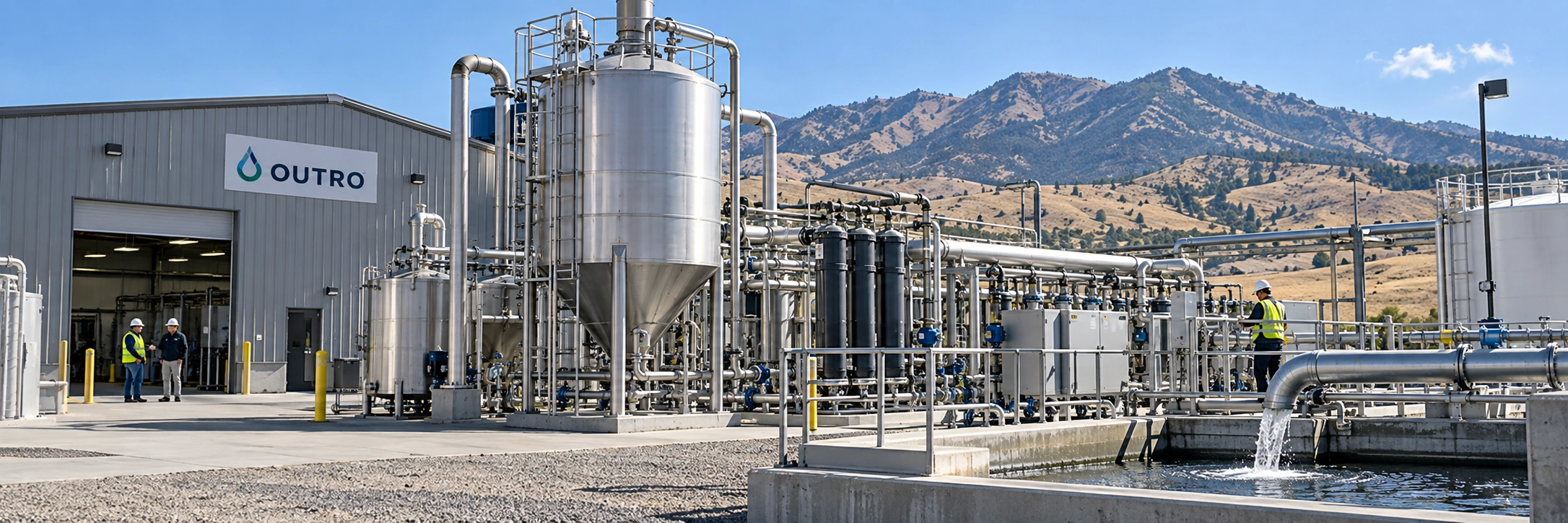
Outro’s plants do not make minerals disappear. The treatment train changes the chemistry of mineralized groundwater under controlled conditions so dissolved mineral ions form recoverable solids. Seeded precipitation, pH management, staged reactors, filtration, and polishing separate those solids from the water. The remaining water is tested against the standard required for its final use.
Engineers were skeptical of early political descriptions that made the process sound effortless. Precipitation chemistry depends on the exact water source. Different aquifers contain different mixtures of calcium, magnesium, silica, sulfates, salts, metals, and trace contaminants. A treatment system that works efficiently in one basin can require a different sequence in another. Idaho therefore required source-specific pilot work before a plant could qualify for state support.
The state also required a full accounting of the solids. Where recovered minerals met industrial specifications, operators could sell them into approved markets. Material that could not be reused had to enter controlled disposal streams. The program never counted a gallon as recovered until the treatment residue had an approved destination and the water met its permit.
The Eighteen-Billion-Gallon Number
By the mid-2050s, plants operating under the Idaho partnership were reclaiming more than 18 billion gallons of usable water in a typical year. That is roughly 55,000 acre-feet. It is meaningful at state scale, although it is not a replacement for Idaho’s major river systems or reservoirs.
The figure is also a recovery number, rather than a promise that every gallon becomes municipal drinking water. Depending on source chemistry and local need, treated water can support industrial processes, aquifer management, municipal non-potable systems, some agricultural uses, or further treatment for higher-quality applications. Local water authorities decide where a recovered supply belongs.
That distinction mattered to Chastain. Her office resisted the temptation to advertise a single technology as a cure for drought. The program was built as one more source in Idaho’s portfolio, useful precisely because it reduced demand on higher-value fresh water.
Who Paid for the Plants
Idaho’s agreements with Outro and later licensees were structured around performance. State support was tied to completed capacity, verified recovery, water-quality compliance, and local off-take agreements. A plant could not qualify for the full benefit based on an announcement or a laboratory projection.
Where public infrastructure was involved, local utilities retained control over interconnection and water distribution. Private industrial customers could contract directly for recovered water when that arrangement made sense. State financing tools were aimed at treatment equipment and shared infrastructure with a long service life.
The policy also kept a line between the water program and the compute boom. Underground data centers were already required to minimize consumptive cooling water. Their presence did not create an automatic claim on recovered supplies. A center that wanted treated water had to compete under the same local allocation rules as any other industrial user.
Energy, Aquifers, and the Engineering Objections
Water treatment consumes energy. Pumps move groundwater and process streams. Reactors, filters, separation equipment, controls, and polishing systems all require power. Idaho therefore evaluated recovery plants on energy per gallon as well as gallons produced. Sites with poor chemistry or excessive pumping requirements could fail the economic test even when the chemistry worked.
Hydrogeologists raised a different concern: taking previously unusable groundwater out of an aquifer can still change the aquifer. The state required pumping limits, observation wells, subsidence monitoring where relevant, and basin-level review of cumulative withdrawals. Recovery technology did not override Idaho water law or local hydrology.
Plants were also required to account for reinjection, discharge, or conveyance water where those pathways were used. The central rule was that a treatment project had to improve the basin’s usable-water position without quietly transferring contamination, salinity, or depletion to somebody else.
What Changed After 2044
Chastain entered the U.S. Senate in 2044 with Idaho’s early plants already proving the concept. Her federal role helped move the program beyond isolated state projects. She worked to make advanced groundwater recovery eligible for federal water-resilience financing, pushed for faster coordination among federal agencies on treatment demonstrations, and backed research funding for precipitation chemistry, membrane polishing, mineral recovery, and long-duration aquifer monitoring.
Federal participation mattered most in places where a water project crossed jurisdictional lines or served rural communities that could never finance a large treatment plant from local rates alone. Idaho retained control of its water allocations while federal programs helped finance infrastructure with regional value.
Why It Fit the Larger Idaho Strategy
The water program became part of a broader rule that Chastain and the governor applied to new technology: economic development had to carry its own physical costs. Data centers could not build a business model around Idaho reservoirs. Large industrial projects could not assume that household customers would fund their utility expansions. Water recovery had to prove that the aquifer, treatment chemistry, and disposal plan worked before the state counted the supply.
That discipline made the program slower at the beginning. It also made the results easier to defend. Idaho gained a significant new source of usable water without presenting the technology as free water and without asking existing users to surrender their place in line.
For Chastain, the measure of the policy is straightforward. More than 18 billion gallons now enter useful service each year that previously could not. Reservoir pressure is lower than it would have been under the same growth. The state still treats water as a finite resource.